Thursday, October 22, 2009

Guerrilla Girls (Hannah Miller)


The Guerrilla Girls are a group of feminist artists that call themselves the "Conscience of the Art World". They formed in 1985 in response to the rampant sexism and racism they saw in the art world. They originally focused on the art museums in New York City and more recently have branched out into other countries as well. They examine the gender imbalances within museums and art shows and since have also looked at this gender imbalance in the film industry and pop culture in general. They use creative posters and other displays on a wide scale throughout cities in order to get their activist messages across. They want to "rehabilitate the 'F-word', feminism" and make it so that more people will want to call themselves feminists and work for women's rights.

This is one of their most famous works which addressed the 1984 exhibition An International Survey of Painting and Sculpture at the Museum of Modern Art in which only 13 out of the 169 artists included were women—none of them women of color. This is the event that propelled them into action and thus the Guerrilla Girls were created in 1985.


The Guerrilla Girls use humor very strongly within their work while they are addressing such serious issues. One example of this is within this poster.


They wear gorilla masks when they present their work because they believe that their anonymity makes their message stronger. To go along with this they adopt alternate names which are the names of famous female artists of the past. Their name is a play on the idea of guerrilla warfare because they don't want people to know who they are going to target next. They have expanded and in 2001 they split into Guerrilla Girls, Inc., GuerrillaGirlsBroadBand and Guerrilla Girls On Tour. This has allowed them to reach a greater audience and spread their message to more and more people and locations. They have also published a number of books including The Guerrilla Girls Bedside Companion to the History of Western Art, Bitches, Bimbos and Ballbreakers, The Guerrilla Girls Illustrated Guide to Female Stereotypes and The Guerrilla Girls Art Museum Activity Book.

A few more of their posters and billboards, which shows how they use facts and bold graphics to prove their point and work for women's rights.


(click on the images to make them larger)

This video gives a great overview to the Guerrilla Girls that discusses their goals, their history and provides a great deal of images. It is a presentation by two of the Guerrilla Girls at the MOMA Feminist Future Symposium.

http://www.youtube.com/watch?v=EHVBZh5HBgc

Their website is-
guerrillagirls.com

I had heard of the Guerrilla Girls before this project but after doing research I like them even more. I think it is very interesting how they chose to get their messages across and how they like to maintain their anonymity. I think their images are aesthetically pleasing as well as being very powerful in their message. I also appreciate the humor that they use and I really enjoyed researching them.

Vito Hannibal Acconci

Biography:
Born January 24, 1940, Vito Acconci resides in New York City were he practices as a architect, landscape architect, and installation artist. Vito is the son of an Italian immigrant father who raised Vito in the Bronx, taking his son to see museums, plays, and other art events. Vito too a like to architectural aspects and went to school at the College of Holy Cross, then to University of Iowa. He then taught at Nova Scotia College of Art and Design, Halifax; California Institute of the Arts, Valencia; School of the Art Institute of Chicago; Yale University; and the Parsons School of Design. He currently teaches part time at Brooklyn Colleges Art Department.

Some of his Art Work.


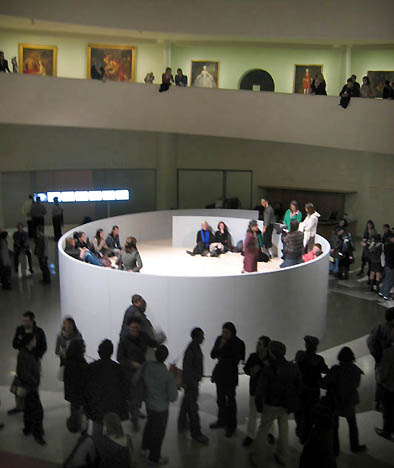
Performance Vito Acconci’s Seedbed (1972) at the Guggenheim Museum

For more about Vito Acconci you can visit
http://www.designboom.com/eng/interview/acconci.html - A interview on Vito Acconi or his website at
http://www.acconci.com/

learningtoloveyoumore (Harrell Fletcher)

Submitted by Rachel Reed

Learningtoloveyoumore is a website made of a series of presentations made by the public. The presentations are responses to assigned tasks given by Harrell Fletcher and Miranda July. Since the project was started in 2002, over 8000 people across the globe have participated, and many of the displays can be seen in exhibits across the world. Assignments range from taking pictures to drawing, writing, or performing- but all tasks must somehow be documented so they can be displayed on the webpage. There are 70 tasks on the page right now, but this number continues to grow so people can continue submitting new responses to tasks. On the website, learningtoloveyoumore.com, you can see all the assignments and the work people have submitted in response. Some of my favorite assignments are:

#3 Make a documentary video about a small child
#6 Make a poster of shadows
#9 Draw a constellation from someone’s freckles
#14 Write your life story in less than a day
#25 Make a video of someone dancing
#27 Take a picture of the sun
#33 Braid someone’s hair
#40 Heal yourself
#41 Document your bald spot
#50 Take a flash photo under your bed
#55 Photograph a significant outfit
#58 Record the sound keeping you awake
#69 Climb to the top of a tree and take a picture of the view

Here are some of the responses from several assignments, as posted on learningtoloveyoumore.com:

#27 Take a picture of the sun


Submitted by:
Federica Bertorelli
Fidenza, ITALY


Submitted by:
Janna
Stavanger, NORWAY


Submitted by:
Cesar Castro
Chicago, Illinois USA

#69 Climb to the top of a tree and take a picture of the view


Submitted by:
Alex
Dublin, IRELAND


Submitted by:
Janna
Stavanger, NORWAY


Submitted by:
Jethro
Provo, Utah USA


Submitted by:
Ed Murphy
Dublin, IRELAND


Submitted by:
Stephanie Ognar
Champaign, Illinois USA


#55 Photograph a significant outfit


"What i was wearing when i realised i could be happy again; my 20th birthday."
Submitted by: Helen
Bishop's Stortford, Hertfordshire ENGLAND


"This is what I was wearing when I found out how poor I actually am."
Submitted by: Zoe
Boston, Massachusetts USA


"This is what I was wearing when I gave it all away and I didn't even care."
Submitted by: E.M.
Alexandria, Virginia USA


"What I wore the day I got married."
Submitted by: Shaun T.
Austin, Texas USA


"This is what I wore when I signed the contract for my first studio."
Submitted by: Julia Vitalis
Berlin, GERMANY


"What I was wearing the night he and I ended up dancing in the street at 6 AM"
Submitted by: Alba Mayol
Barcelona, SPAIN

In addition to the learningtoloveyoumore project, Harrell Fletcher continues to work on projects that socially engage the public. He works across the glove with a variety of groups including universities, schoolchildren, disabled adults, and countless other groups. He bases many of his projects on responses to books, movies, historical events, etc, but also has many creative ideas of his own. In a specific project in Brittany, France, Fletcher observed peoples responses to sculptures in a local park. He then asked local park-goers what kind of sculpture they would like to see in their park, and had them draw proposals of their ideas. An 8 year old boy proposed the idea of a turtle painted green and gold, and Fletcher liked this idea so much he helped the boy turn his idea into a sculpture that is still in the park today. As seen in this instance, Fletcher truly engages the public in his projects and acts as a facilitator to people in the sense that he gives people an idea to think about, then helps them turn their visions into concrete pieces of art.

Photos of the process of creating turtle scupture:


sources:www.harrellfletcher.com and learningtoloveyoumore.com

Wednesday, October 21, 2009

Martha Rosler - (Caitlin Size)


This is some of the Martha Rosler’s work that we have seen.


We have already seen some of Rosler’s work. A lot of it is an artistic commentary on everyday life or everyday objects. She will commonly give her work a distinctive woman’s perspective. Her performance piece “Semiotics of the kitchen” is no different. It is a look at the idea of a housewife and the tools they use throughout the day. In this piece Rosler lists kitchen utensils, one for each letter, as she picks up that utensil and demonstrates what it is used for. Her motions with each utensil become abrasive and almost aggressive. The piece is a commentary on the views of women in 1975.

http://www.youtube.com/watch?v=3zSA9Rm2PZA

Rosler was born in Brooklyn, NY. She received her BA from Brooklyn College in 1965 and her MFA from the University of California, San Diego in 1974. She works mainly in photo, text, installation, and performance as well as being writing as a critic.

Rosler currently teaches at the Mason Gross of the Arts at Rutgers University.

Adrian Piper (Erin Saul)

Dr. Adrian Piper is well known for her conceptual and performance based artwork in the 1980’s. Her work brings performance to minimalism as well as issues that she faces as a black woman in America. Dr. Piper has put many dents in the glass ceiling throughout her career including being the first Black woman to be tenured in the field of Philosophy. She focuses her academic exploration in the study of Kant, metaethics, and social ethics.

http://www.youtube.com/watch?v=yUJ8MhXTwtI

One of her most well know works is “Cornered”. She addresses the many gender and racial issues while wearing a “school teacher” costume. She asserts herself as a black woman, and she questions why she has been told by society to pass as white. She brings the viewer in close to the screen where her performance is shown, and makes an intimate connection with the viewer. The intimacy makes some uncomfortable, especially as she bitingly addressed the harmful effects of sexism and racism.

She questions social boundaries and her “place” in society in her pieces “My Calling Card #1 and #2”.

http://images.artnet.com/images_US/magazine/features/saltz/saltz4-23-08-34.jpg

http://www.asu.edu/cfa/wwwcourses/art/SOACore/piper1.jpg

Jenny Holzer (Emily Coldiron)

Background:
Jenny Holzer was born in Gallipolis, Ohio in 1950. She attended Ohio State University, the Rhode Island School of Design, and New School University. Much of her work deals with the power of words and statements. Her performance pieces have been executed on some of the most famous buildings in the world, including the Reichstag and the Louvre.


She has had exibitons in several well-known art galleries. Some pieces have been exhibited in the Guggenheim in New York and the Contemporary Arts Museum in Houston. Not all of her work is performance-based, she also prints sayings on unconventional items such as condoms and various posters.


This is an interview where she discusses some of the texts she uses

A lot of the words and aphorisms Holzer uses come from cliche sayings and common phrases. She does use some of her own words in her pieces, but she also incorporates words drom outside sources. In one piece, she silk-screened text from declassified government documents detailing prisoner abuse.


I think the most interesting aspect of her work is the fact that she exposes truth through words and phrases in the weirdest places. It creates a certain atmosphere and background for the words, and gives them a new meaning. One of her works, titled "Truisms," dealt with the idea of truth in particular, and it was composed from a lot of her own ideas of what truth is and how we view it.
Chris Burden


brief biography:

born: 1946 Boston, MA, grew up in France and Italy
    -at twelve, had motorcycle accident and had surgery on left foot without anesthesia, formative nexperience

BA in visual arts, physics and architecture from Pomona College

MFA University of California, Irvine

1978 became Professor at University of California, LA
      -resigned in 2005 over mishandled controversy over students work who echoed his own (involving a loaded gun)

performance artist through seventies, moved into installation art

currently lives and works in LA

basic concepts:

personal danger as artistic expression : Most of his work was during and after the vietnam war, so it seems to me that a great deal of his work has to do with bringing violence to the forefront, and asking people to recognize that violence is not exclusive - it can happen to anyone. There is a clear exploration of basic human fears (outside of the context of the vietnam war) that are usually left unspoken, and presented in a way that shows the artist actually experiencing these fears. (being shot, crucified, starving to death, socially ostracized, etc.) The fears become more knowable and less mysterious, less cryptic. Exploration of psychology and social occurrences.

And there is an obvious attempt to make the viewer uncomfortable, physically and mentally, perhaps to trigger new trains of thought?... "alternative" artist

I think this article is an interesting interpretation of Burdens work and intent. Its not too long! Read it!


brief timeline of some performance pieces:

1971: Five Day Locker Piece : Burden's MFA exhibition, five days in a locker with five gallons of water above him and a five gallon bucket below him. no other interaction with outside world, only limited number invited, no documentation

-Shoot : Burden had an assistant shoot him in the arm with copper jacket 22 long-rifle from a distance of 5 meters.

1972: Deadman :Burden covered himself with a tarp and lay in the middle of the road, with two flares on other side of him that would eventually burn out and increase the risk of being run over

-TV Hijack :When interviewed by television host, unplanned and unexpectedly held interviewer at knife point.

1973: B.C., Mexico : Experience of "starving to death."

-Fire Roll : “I began the evening watching television, smoking and drinking beer. The other artists were preparing their pieces. People were filling the museum and my activity went almost unnoticed. After about an hour I got up and went around the room turning off all the lights. I had a pair of old pants which had been passed around by many of my friends. I placed the pants on the floor and saturated them in lighter fluid. I lit the pants on fire and extinguished the flames with my body. I turned on the lights and returned to watching television.” -Burden

-747: “At about 8 am on a beach near the Los Angeles International Airport, I fired several shots with a pistol at a Boeing 747.” -Burden

1974: Trans-fixed : Burden had an assistant nail him to a Volkswagon by means of nails through his hands.

-White Light/White Heat :  "For my one-man show at Ronald Feldman, I requested that a large triangular platform be constructed in the southeast corner of the gallery. The platform was ten feet above the floor and two feet below the ceiling; the outer edge measured eighteen feet across. The size and height of the platform were determined by the requirement that I be able to lie flat without being visible from any point in the gallery. For twenty-two days, the duration of the show, I lay on the platform. During the entire piece, I did not eat, talk, or come down. I did not see anyone, and no one saw me." -Burden

1975: Doomed : "Burden’s most trenchantly significant work was “Doomed,” performed in April, 1975, at the Museum of Contemporary Art in Chicago. He set a clock on a wall at midnight, and lay down on the floor under a leaning sheet of glass. Viewers came and went. Burden didn’t move. Inevitably, he soiled his pants. (“It was awful,” he recalled.) Forty-five hours and ten minutes passed. Then a young museum employee named Dennis O’Shea took it upon himself to place a container of water within Burden’s reach. The artist got up, smashed the clock with a hammer, and left." -The New Yorker

1979: Honest Labor : Burden spent three days digging a ditch alone while acting as a visiting artist

2005: Ghost Ship (combination installation/performance)
-"his crewless, self-navigating yacht.... was funded with a significant grant from the UK arts council, being designed and constructed with the help of the Marine Engineering Department of the University of Southampton. It is said to be controlled via onboard computers and a GPS system, however in case of emergency the ship is 'shadowed' by an accompanying support boat." - wikipedia

video clips:

“Shoot” -
http://www.youtube.com/watch?v=26R9KFdt5aY

“The Flying Steamroller” - 2nd through 18th October, 2006
http://www.youtube.com/watch?v=m9K69zHLIeY

Burden about some of his installations
http://www.youtube.com/watch?v=JfOlIueMjpE&feature=related