Wednesday, October 21, 2009

Lisa Choban's Project on the Artist Orlan


The artist Orlan was born on May 30, 1947 in Saint-Etienne, France. Currently, she resides in Paris, New York City and Los Angeles. Orlan is a professor of fine arts at the Ecole des Beaux-Arts in Dijon, France and she also on the board of administrators for the Palais de Tokyo in Paris. In 1982 Orlan founded the first on-line magazine of contemporary art. Orlan chooses to keep her personal information and life history vague. This ambiguity helped propel and maintain Orlan’s status as a famous cultural icon.

Orlan’s most famous pieces of artwork are the nine plastic surgeries, which altered her face. The purpose of these surgeries was not to become more beautiful. Orlan states, “My goal was to be different, strong; to sculpt my own body to reinvent the self. It's all about being different and creating a clash with society because of that. I tried to use surgery not to better myself or become a younger version of myself, but to work on the concept of image and surgery the other way around. I was the first artist to do it." Orlan also performs these surgeries to show women that “female beauty is constructed by men for the pleasure of men.”

Orlan’s surgeries attempted to alter her facial features to reflect those of iconic women in art history. For example, one operation changed the shape of Orlan’s mouth to make it look more like the mouth of Francois Boucher’s Europa. Another changed her chin to look like that of Botticelli’s Venus. The two implants on Orlan’s temples are a result of misplaced cheekbone implants used to mimic the protruding browline of DaVinci’s Mona Lisa.

Orlan also insists on filming her operations. Famous designers give Orlan gowns to wear when she undergoes these surgeries. Music and poetry is often played or recited during her operation as well. Orlan also chooses to remain under local anesthesia, which means she is awake and conscious for her surgeries. Orlan chooses to make a spectacle of her surgeries in order to show that the risk and process to achieve beauty is truly dangerous, ugly and horrifying.

Orlan has also created many other works of art using many different mediums that all comment on the female body image and the female’s place in history and society. Many of these photos and paintings involve Orlan taking graphic images of her own nude body. Many of these works are of Orlan mimicking many famous historical pieces involving women’s bodies.

LAURIE ANDERSON


LAURIE ANDERSON


Brief Biographical Information:

- Born in Chicago, IL 1947

- Graduated from Barnard: Art History degree

- MFA in sculpture from Columbia University

- Spent the 1970s working as an art instructor and critic for various magazines, and illustrating children’s books

- She has collaborated with visual artists (such as Robert Rauschenberg) and choreographers (Trisha Brown) in order to create elaborate performances

Performance Art:

Her art incorporates a variety of media: music, video, storytelling, projected imagery, sculpture, etc.

- “Duets on Ice” (1970s): she played the violin along with a recording, while wearing ice skates that were no longer functional, because the blades were frozen in a solid block of ice. She continued playing until the blocks of ice had completely melted.

- “United States I-IV” (1983): combined music, photography, film, drawings, and animation with text. 78 segments organized into four parts: Transportation, Politics, Money, and Love.

- “The Nerve Bible” (1995): based on the book of her work. She travelled on a tour in which she read excerpts from her book while incorporating music, comedy, illusion, dance, film, songs, and a simulated tornado into her performance.

- “Songs and Stories from Moby Dick” (1999): A multimedia, musical performance of the book.

- “The End of the Moon” (2004): she was appointed the first artist-in-residence of NASA.

Music & Film:

- “It’s not the Bullet that Kills you – It’s the Hole” (1977)

- “O Superman” (1981): half-sung, half-spoken --- surprisingly successfully, propelled her into the music world. It is in part a cover of a song from Le Cid, but very minimalist. See video below:

- She has released seven albums for Warner Bros.

- Short film: Hidden Inside Mountains --- she received a great deal of acclaim for this project

Books:

- She has published six books

Inventions:

- Tape-bow violin (1977): uses recorded magnetic tape in place of the traditional hair on a bow, so that recordings can be manipulated with the playing of her violin

- Talking stick (1999-2000): 6-foot long MIDI controller: a wireless instrument that can access and replicate any sound

Comments:

- I chose Laurie Anderson, despite being relatively unfamiliar with her art, because I recognized her name (I own some of her music, and was unsure whether the artist and the musician were the same person). I also knew that Lou Reed was married to a Laurie Anderson, but again, was unsure whether this artist was the same. Turns out, they are!

- It is interesting that her art is that of performance, since she has had a long interest in music, and performance art really allows the art to penetrate more than one sense (performance art is typically not simply a visual experience).


Hannah Hansens Reed Collage


Hannah's collage can be found in the photo classroom, if you want to see it in the flesh. There is fabric behind the images, which may not show up particularly well as a blog post. Comments and feedback for Hannah, Tristan, David and Kyle are appreciated.

Prof. Wilson

Tuesday, October 20, 2009


For some reason, two of the other videos were posted and this one wasnt. This is the trailer for a documentary about the Yes Men and the pranks they have pulled. The first video is about a prank they pulled where 1,000,000 copies of a fake New York Times were printed and sold with the headline being The Iraq War is over.

The Yes Men Research, Alex Benedick

The Yes Men is a group of culture jamming activists who practice what they call "identity correction" by pretending to be powerful people and spokespersons for prominent organizations. From their offices in Milwaukee, they create and maintain fake websites similar to ones they want to spoof, and then they accept invitations received on their websites to appear at conferences, symposia, and TV shows. Their newfound, self-proclaimed authority to express the idea that corporations and governmental organizations often act in dehumanizing ways toward the public has met both positively and negatively with political overtones. Elaborate props are sometimes part of the ruse, as shown in their 2003 DVD release The Yes Men.

Their method is often satire: posing as corporate or government spokespeople, they often make shocking comments which they believe to be the real meaning of the organisation's ideology being hidden by spin, or extrapolate what they feel is the organisation's ideology in a 'reductio ad absurdum' to come out with outrageous conclusions, such as that it should be possible to sell your vote or that the poor should eat recycled human waste. On most occasions no shock or anger has been registered in the response to their prank, with no one realizing they were imposters. Sometimes, the Yes Men's phony spokesperson makes announcements that represent dream scenarios for the anti-globalization movement or opponents of corporate crime. The result is false news reports of the demise of the WTO, or Dow paying for a Union Carbide cleanup, which the Yes Men intend to provide publicity for what they see as problems in the current situation.

The Yes Men have posed as spokespeople for The World Trade Organization, McDonalds, Dow Chemical, and the United States Department of Housing and Urban Development. The two leading members of The Yes Men are known by a number of aliases, most recently, and in film, Andy Bichlbaum andMike Bonanno. Their real names are Jacques Servin and Igor Vamos, respectively. Servin is an author of experimental fiction, and was known for being the man who inserted images of men kissing in the computer game SimCopter. Vamos is an associate professor of media arts at Rensselaer Polytechnic Institute, New York. They are assisted by numerous people across the globe.

Marina Abramovic (Eliza Hastie)

Marina Abramovic, “The Grandmother of Performance Art,”

Abramovic was born on November 30, 1946 in what is now Serbia. Performance art for her was a way to rebel against “the post-war miseries.” She pushes the limits of physical and mental potential. Throughout her career as a performance artist, she has lacerated herself, flagellated herself, frozen her body on blocks of ice, taken mind- and muscle-controlling drugs causing her to fall unconscious, and nearly died from asphyxiation. Her work strives to investigate “the relationship between performer and audience, the limits of the body, and the possibilities of the mind.” She has used her own body as a medium to work with and manipulate since she started performing many years ago. Her goal is to figure out a way using art to make people grow freer.


Abramovic had an interesting childhood and was raised by a former major in the army, her mother. She was forbidden to be out of the house past ten at night. This went on until Abramovic was 29. I think it explains where some of her bizarre ideas come from, being so cooped up for so long.
Abramovic attended the Academy of Fine Arts in Belgrade from 1965-1970. She attended the Academy of Fine Arts in Zagrab, Croatia in 1972 for her post-graduate studies. She taught at the Academy of Fine Arts in Novi Sad from 1973-1975. During this time she began to start her first solo performances.

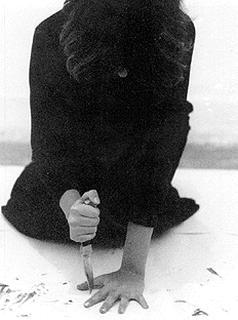
Abramovic’s performance art largely deals with pain. In her work Rhythm 10 (1973), she played the Russian game in which one jabs the knife in between each finger at great pace attempting not to slice into one’s fingers. She used twenty knives and would move onto the next knife after she cut herself each time, tape recording the performance. She then replayed the tape, studying the sounds and tried to recreate the same performance again, making the same mistakes in tune with the first time around. She then listened intently to the double sounds and the painful cries the caused. Abramovic said, "Once you enter into the performance state you can push your body to do things you absolutely could never normally do,” on the state of consciousness she achieved while performing.


One of my favorite pieces of Abramovic is Rhythm 0 (1974). In this piece she sought to explore the relationship between performer and audience at an extreme extent. She had a table with 72 objects on top of it. These objects were made up of ones that could generate pleasure as well as ones that could inflict great pain. Some of the objects were scissors, a knife, a whip, and a gun and a single bullet. She then gave the audience six hours to do whatever they would to her, letting them do anything to manipulate her body. At first, the audience proceeded very cautiously and barely touched the more harmful objects. But, due to Abramovic’s impassiveness most likely, with time the audience grew colder and more malignant. Abramovic described the experience this way: “The experience I learned was that…if you leave decision to the public, you can be killed...I felt really violated: they cut my clothes, stuck rose thorns in my stomach, one person aimed the gun at my head, and another took it away. It created an aggressive atmosphere. After exactly 6 hours, as planned, I stood up and started walking toward the public. Everyone ran away, escaping an actual confrontation.”


Another mentionable work of Abramovic’s was Seven Easy Pieces (2005). It was presented at the Guggenheim Museum in New York City. For seven consecutive nights for seven hours, Abramovic recreated the works of five performance artists that had been first done during the 60’s and 70’s. All of their performances were very difficult and draining, involving great concentration both physically and mentally from her. The pieces performed by Abramovic during Seven Easy Pieces are as follows: Bruce Nauman’s Body Pressure (1974), Vito Acconci’s Seedbed (1972), Valie Export’s Action Pants: Genital Panic (1969), Gina Pane’s The Conditioning (1973), Joseph Beuy’s How to Explain Pictures to a Dead Hare (1965), Abramovic’s own Lips of Thomas (1975), and Abramovic’s own Entering the Other Side (2005).
The prizes and awards Abramovic has won are the Golden Lion Award, VLVII Venice Biennale (1997), the Niedersachsischer Kunstpreis (2003), the New York Dance and Performance Award (The Bessies) (2003), International Association of Art Critics, Best Show in a Commercial Gallery Award (2003), Honorary Doctor of Arts, University of Plymouth UK (2009).


“...as I entered the Mona Lisa room — you know, the painting is so removed from reality that any postcard seems more real.”
-Abramovic


“All my work is about emptying the mind, to come to a state of nonthinking. But to answer your question about cultural limits, I don’t have any feeling of nationality. I travelled so much that I really took the whole planet as a studio. And in a way I even think it’s too small.”
-Abramovic


“In my new work is based on the idea that what is important is less what you do than the state of mind you do it in. Then you must make enormous efforts to come to that state of mind. According to this, my new work deals with emptying my body: “Boat emptying, stream entering.” This means that you have to empty the body/boat to the point where you can really be connected with the fields of energy around you. I think that men and women in our Western culture are completely disconnected from that energy, and in my new work I want to make this connection possible.”
-Abramovic


“As an artist I want to be a bridge.”
-Abramovic


works cited:

http://en.wikipedia.org/wiki/Marina_Abramovi%C4%87

http://www.artfacts.net/index.php/pageType/newsInfo/newsID/3352/lang/1

http://www.christies.com/LotFinder/lot_details.aspx?intObjectID=5207889

http://www.jca-online.com/abramovic.html

http://www.lacan.com/abramovic.htm

http://www.mutualart.com/Artist/Marina_Abramovi%C4%87/4E03122AC26348A1